I’ve found this video series to be very helpful
Formula for Linear Separable First order ODE
- Write in standard form
- Determine integrating factor
- General solution
Only add the integrating factor here, at the end
Bernoulli Equations
In the form:
Where r is any real number other than 0 or 1.
- Divide by
-
Substitute and it’s derivative
Following U-Sub rules..
$y^r$ and $y^{-r}$ cancel..
-
This is now linear, first order, and separable. Solve as such
-
Back substitute, and solve for y
Higher Order ODE’s
Existence & Uniqueness
For
And
If are continuous on an interval I containing a, then there exists a solution on I which is unique
Superposition
For
There are necessarily two general solutions, and any linear combination of them is also a solution. Additionally, if and are linearly independent, then all solutions are a linear combination of them.
Homogeneous With Constant Coefficients
For
Substitute
Solve as a quadratic, by factoring or by using the quadratic formula.
You will at this point have either two real and distinct values for r, or a repeated real root, or complex roots.
Distinct Real
Then just plug in your two initial values (one for , one for ), and solve for ,
Repeated Real
This occurs when
Complex Roots
This occurs when
the roots are:
So the two general solutions are:
is a solution because it is a linear combination of solutions.
This leads to: and as valid general solutions, which are linearly independent, and real valued.
So a specific solution takes the form:
and
Non Homogeneous with constant coefficients (Undetermined Coefficients)
The sum of the solution to the homogeneous variation of the ODE and any particular solution is a solution to the non-homogeneous ODE
-
Find the homogeneous solution
-
Remove the coefficient from the right side, then plug it in with an undetermined coefficient in place, to find the value of that efficient.
For:
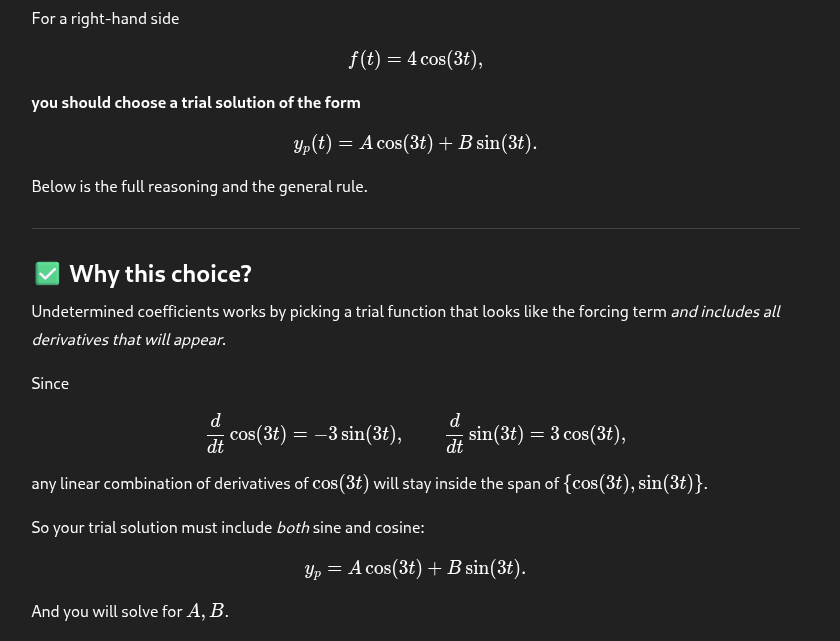
Plug in :
Derrive:
So one particular solution is:
Since the solution to the homogeneous is: , the general solution is:
Remember that you must solve for the general solution before implementing the initial value.
Also, if the right side matches the form of any term of the homogeneous solution, then try as the undetermined coefficient, instead of just
Variation of Parameters (for second order)
Used when the coefficients of , etc are not constants.
-
Solve the homogeneous
-
Guess that
-
Use the formulas:
Where is a function of x (the right side of the equation), when the coefficient of is 1
The Wronskian
A way to figure if functions are linearly independent
Form a square matrix and take it’s determinate:
If it’s determinate is non-zero in at least one place, then they are linearly independent.